
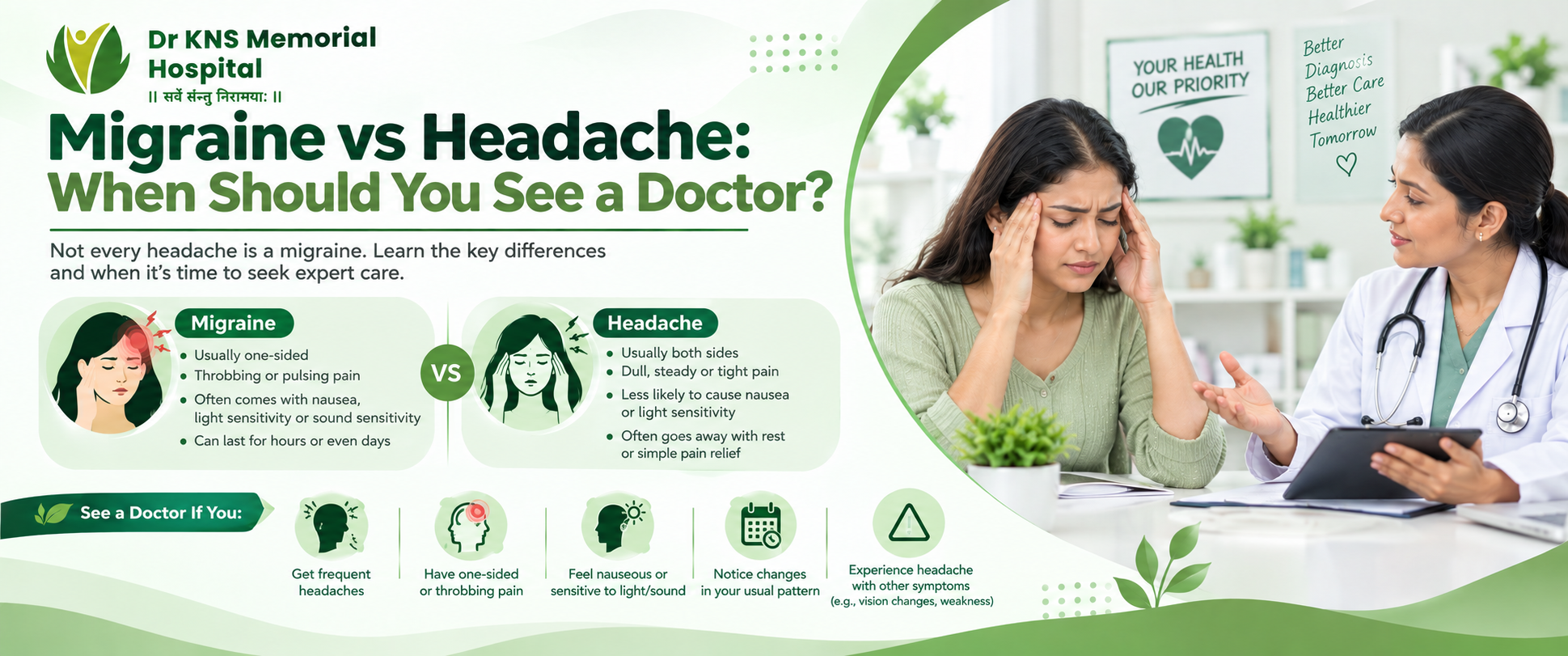
Most of us know that one day where your head is just pounding, whether it's from hours in front of the computer screen, an empty stomach, or an interrupted night of sleep. You know, when your head just keeps pounding and pounding, almost like its protesting all these elements? But then, what if this pain comes with the added element of nausea, light sensitivity or a strange shimmering in your visual field that occurs before the attack even begins? Ah, that's where all this get's tricky, because who simply ascribes a particularly migraine vs headache? Or do you know how many years of trial and error, no treatment and suffering you could save yourself?
Jump into this blog that takes away the mystery of the difference between migraine and headache. Find out where you tend to feel the pain, what sets it off and, most importantly, when you can skip the bed rest and head straight for your doctor's office.
What Exactly Is a Headache?
A headache, as simply as we can put it, is a pain somewhere in the head, scalp, or neck. They are, after all, a symptom, not a disease. The majority of headaches experienced are classified as what doctors call primary headaches, meaning that no other condition or injury is in the background. Tension headaches are the most common category, and are often described as a band of pressure around the scalp caused by stress, dehydration, lack of sleep, or squeezing over the screen of your computer.
The good news about a typical headache is that it seldom brings you to a halt. You can often get through a meeting, have a good chat, or just take a walk around the block without much issue. It's amenable to rest, water, and a quick dose of an over-the-counter pill, and it will be gone in a matter of hours instead of days.
What Is a Migraine, Then?
To be honest the answer to this is it's not just a bad headache. Migraine isn't just a severe headache, but a trigger in the brain that causes a sort of storm in the nervous system. When a migraine hits, the pain pathways in the brain become hypersensitive, so people don't simply experience pain, they experience everything else more intensely too - sound, movement, light and even odour.
Typically, a migraine attack will have at least two of these features: it is either unilateral (on one side of the head), throbbing, moderate to severe in severity, and worsens with activity (such as climbing stairs, or bending over). There's also nausea and/or vomiting or a desire to rest in a dark, quiet room. Auras are common, such as flashing lights or blind spots, or pins and needles in the area where the pain will be.
Migraine vs Headache: Where the Line Actually Sits
This is where most folks will make a mistake, too. Since both headaches and migraines result in head pain, it might seem logical to compare and contrast. However, headache vs migrane reveals a very different picture.
| Feature | Regular Headache | Migraine |
|---|---|---|
| Pain location | Both sides, often like a tight band | Usually one side, can shift between attacks |
| Pain type | Dull, constant pressure | Throbbing or pulsating |
| Intensity | Mild to moderate | Moderate to severe |
| Effect on activity | Daily tasks continue fairly normally | Movement and activity make it worse |
| Other symptoms | Rare nausea, mild light sensitivity | Nausea, vomiting, light/sound sensitivity, aura |
| Duration | A few hours | 4 hours up to 3 days |
Now that you've seen the difference between headache and migraine, it doesn't seem so confusing anymore. A typical headache is just the high-pitched background, while a migraine completely dominates the entire program. And, by the way, headaches and migraine aren't mutually exclusive. It's not uncommon for someone to get both, and often, in one week-which is all the more reason to keep a diary of your symptoms rather than trying to treat each attack individually.
Migraine vs Tension Headache: The Pattern That Confuses Most People
The toughest comparison of all is probably the difference between migraine vs tension headache, since both can be caused by stress. But tense head pain typically doesn't come with nausea or light sensitivity, and it doesn't make you stop everything. Migraine pain will typically send you to the darkened room, and the pain will make everything worse: Light, noise, activity will make it hurt more.
Where Does It Actually Hurt? Understanding Migraine Pain Areas
Could the pain location clues be ignored? It can be easy to dismiss location clues in migraine pain but it's important to recognize that migraine pain doesn't fall out of the sky, it follows patterns. Knowing the migraine pain areas, and sharing them with your doctor, can help you both better understand what's happening.
- A headache at the temple is very common in tension headaches and migraine but in a migraine it usually indicates it's all about light, throbbing, head pain.
- When it's a forehead headache pain, it's most common to be related to sinus pressure or eye strain or something that's happening at the front of the head before the pain spreads.
- If your headache right temple happens all the time, it's usually a sign of unmyelinated axons from one side of the brain to the other, which takes us to specific types of migraine.
- Similarly, left temple headache is just the mirror version, since migraines can switch sides between episodes, and that's completely normal.
- General migraine pain tends to build gradually, peak within an hour or two, and settle in roughly the same regions each time for a given person.
What Does Migraine Actually Feel Like?
If you've never experienced one, it's kind of hard to picture. If you ask a stranger what does migraine feel like, you'll get variations on "it's like I have a drum in my head", or "it's like someone is screwing something into my brain behind my eye", it's not just a headache it's an event that takes up your whole body. Everything is more acute, sharper, louder, even the smell of dinner cooking next door can make you vomit.
Mostly the symptoms of migrane headaches come in stages: a warning stage during which you may notice some mood changes or unusual cravings for certain foods; possibly auras; then the headache, and then a foggy, sluggish hangover that can last an entire day after the pain has passed.
Common Triggers Worth Watching
While all migraine attacks are not provoked by a trigger, a few lists do seem to reappear among those that record the onset of their attacks. Hormonally related triggers, inadequate sleep, missed meals, flashing or bright lights, strong odours and certain foods such as aged cheese, alcohol and caffeine have been identified as common causes. A change in the weather, even barometric pressure, is often noted. None of this will assure a migraine is on the way, but a brief diary noting what was consumed, how one slept, and what the environment was like before symptoms appeared can be useful for the doctor to consider.
Let's put stress under the spotlight here, because it acts in two directions. It can cause an attack and it can also occur during the postdrome of an attack after the pain has gone. Most women will track the connection between their attacks and their period, since the significant decline in estrogen right before their period makes hormonal migraines a separate classification. Even something as ordinary as an irregular sleep schedule on weekends, sleeping in far later than usual, can be enough to set one off in people who are already prone to them.
How Doctors Actually Tell the Two Apart
No blood test or scan can identify "migraine" on a report of your results. It takes only a little of the conversation you have with your doctor, asking the pain's frequency, type, duration and associated symptoms, to tell that this is a migraine. Your doctor will probably also want to talk about your family history, as migraine is far more a family trait than a typical tension headache.
Imaging like an MRI or CT scan isn't needed for most cases. It's reserved for situations where something doesn't add up, such as a headache pattern that's changed suddenly, started after fifty, or come with symptoms like weakness or vision loss that hint at a cause beyond migraine or tension. For everyone else, a clear description of the pain, honestly reported, tells the doctor almost everything they need to know.
When Constant Migraines Become a Bigger Concern
Intermittent migraines can be treated with painkillers and a rest. But if you have constant headaches and the days they appear add up to 15 or more, every month, for three months or more, then it is likely you have a chronic migraine. And that's a new ballgame. The pain, no longer just an annoyance, begins to regulate, control, and distort our hours of sleep and work life. And this is precisely where a self-help approach using painkillers falls short and an appointment for neurological evaluation becomes a necessity instead of a luxury.
Finding the Right Medicine for Headache and Migraine Relief
For a common tension headache, the best medicine for headache is a straightforward over-the-counter medicine such as ibuprofen or paracetamol, with some rest and plenty of water. These tend to be effective because tension headaches are almost exclusively muscular and stress-related.
For migraines, though, the story is different. Your doctor may offer a medication called a triptan, for example, which is aimed at the changes to blood vessels and nerves associated with migraines, plus an anti-nausea drug, if vomiting is occurring. And there's a preventer you can take regularly, if you're having lots of attacks. The key point to note is that the painkillers you use to treat your headache may not be effective at relieving a migraine, and taking painkillers too often can lead to medication-overuse headaches, in its own right.
So, When Should You Actually See a Doctor?
Of course, the majority of headaches (including most migraine headaches) don't require a trip to the ER. However, some signs should never be ignored, and that knowledge might be what helps you get treated, rather than misdiagnosed.
- A new, very severe headache that comes on quickly (called a thunderclap headache).
- Head pain on one or both sides of your head following a head injury or fall.
- A headache with a rash, fever, or stiff neck.
- Problems with your vision, speech, weakness, or numbness in one part of your body.
- A headache unlike any you have had before.
- Headaches that develop for the first time after the age of 50.
- A change in a pattern of migraine headaches that you have been treating with medication.
If any of these show up, it is time to stop letting the headache sit and wait it out, and to see the doctor rather than reaching for another pill. For those with no such warning signs, a headache diary that is kept simple and notes what time of day it happens, its duration and what, if anything, can be identified as its cause, will help the doctor figure out if its tension, the migraine, or if it is something which requires more oversight. If all is fine, a headache is not worth more than a shrug. But a migraine, especially if it is a recurring one, should be worth more than that, and learning to differentiate the two is the first step toward proper relief.
FAQ
A normal headache is a constant pressure or ache that affects both sides of the head, but doesn't limit your everyday activities. A migraine is a neurological disorder that is commonly one-sided, pulsating, accompanied by nausea, sensitivity to light or an aura, and intensifies with movement.
Tension headaches are not usually associated with nausea or sensitivity to light and do not normally interfere with your daily life. If your pain gets worse when exposed to light, sound or movement, or if it makes you lie down, it may be a migraine.
The majority of patients characterize their pain as throbbing or pulsatile, being generalized or localized to one side of the head, with or without the sensation of pressure behind the eye. The pain is of moderate to severe intensity and may be associated with nausea or an aura.
Repeated one-sided temple pain is a typical migraine presentation. Migraines may change sides between attacks, so you'll sometimes have it on the right and sometimes on the left.
Yes, but it's more often related to sinus pressure or eye strain. It's more likely to be a symptom if it occurs with nausea or sensitivity to light.
The symptoms of migraines include: Feeling of throbbing pain (typically on one side), nausea and vomiting, sensitivity to noise and light and sometimes seeing an aura with flashing lights or blind patches before the pain.
Chronic Migraines are when you are experiencing headache days 15 or more days a month for at least 3 months. This is another condition that is not treated with painkillers.
Painkillers such as paracetamol or ibuprofen are usually effective in treating tension headaches. Migraines require more specific medication such as triptans, and anti-sickness medication for the worst cases. It's important to have a diagnosis first.
Get emergency treatment for a sudden, severe headache that reaches its peak within seconds, a headache following a head injury, a fever with a stiff neck, or weakness, numbness or changes in vision. Also, see a doctor if your migraine attacks are increasing in frequency even with medication.
They are not always distinct. People can have tension headaches and migraines, even in the same week and that is why writing symptoms down over time helps a doctor distinguish between the two.